
Critical Research Journal
(MA Photography | Falmouth University)
The tip of the iceberg? Ignorance of AI is leading to some pretty negative consequences.
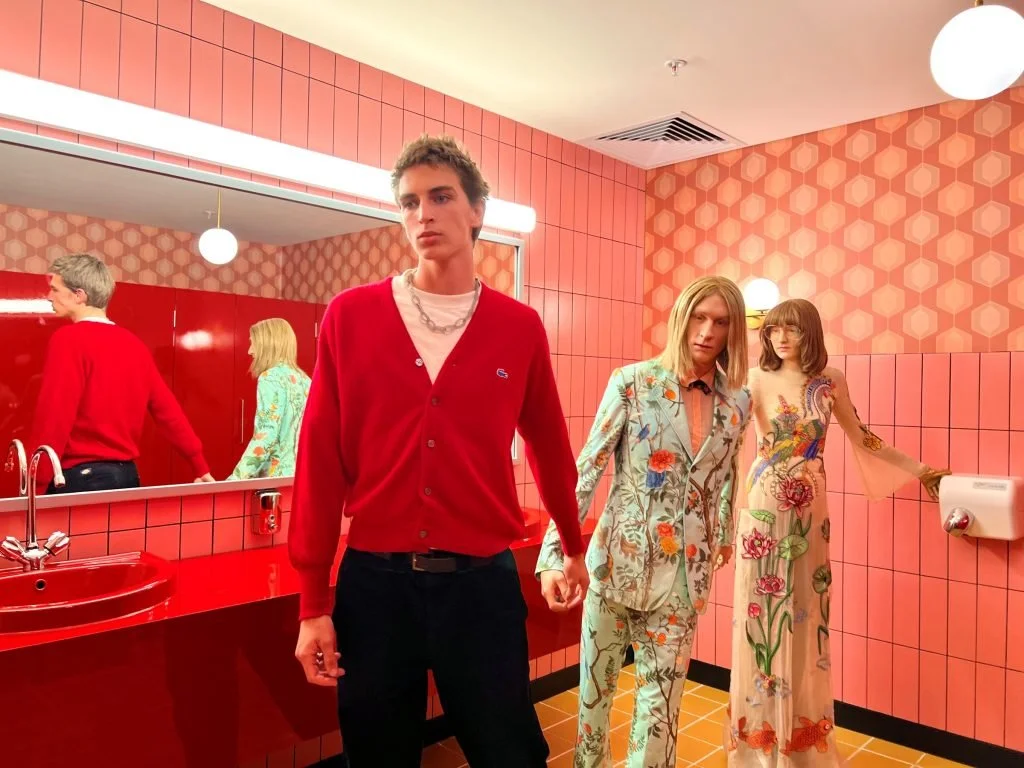
The image above is one of a series from Australian photographer Suzi Dougherty's entry into a Sydney immersive exhibit…
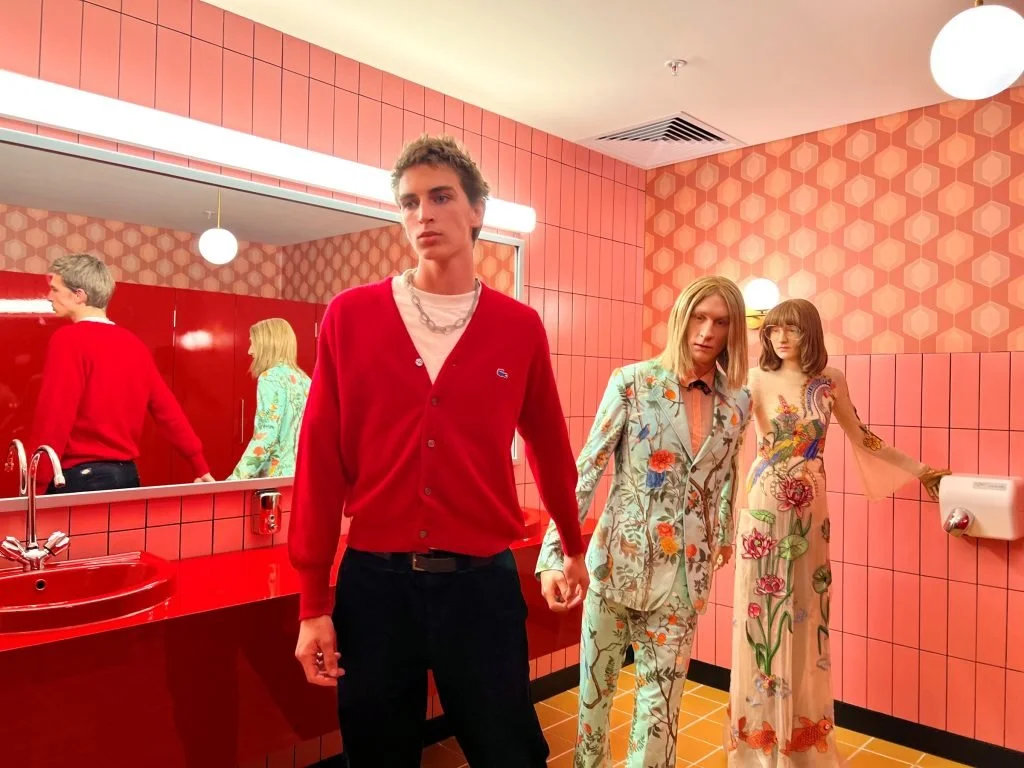
The image above is one of a series from Australian photographer Suzi Dougherty's entry into a Sydney immersive exhibit and contest entitled Gucci Garden Archetypes that explored the fashion giant's advertising campaigns. Featuring her 18-year-old son dressed in a red Lacoste sweater and two mannequins, one male and one female, the photo was disqualified from the competition under suspicion that it was generated by AI (artificial intelligence).
Iain Anderson, the owner of Charing Cross Photo, the print shop that ran the competition, discussed his rationale for disqualifying the entry with Artnet News.
“The mannequins. I just thought the faces were just too … the overall feel of it just felt fake. It was just a well-taken photograph. Her son is a good-looking guy kind of looked mannequin-ish. Too perfect to be true,” Anderson said.
Now, I realize that AI technology is a new phenomenon and is changing and evolving at breakneck speed. It can be put to work in so many useful ways ala Adobe's Sensei and Firefly technology, just to stick with the field of photography.
It also has the potential to do great harm to a great many people through applications like the creation and dissemination of political deep fakes. The general elections are not too far off in the future here in the U.S., so stay tuned to see how it all plays out.
To advocate that AI should be relegated to the dustbin now would be fruitless--and shortsighted. Kind of like screaming into a windstorm, too. You'll just become hoarse and nobody listens anyway.
My biggest gripe, then, is that there are already unwitting victims of AI because of fear and misunderstanding on the part of others. This isn't the first case I’ve heard of where a photographer was shown the door at a competition due to the ill-informed knee-jerk reaction of a judge. Add to that the terror in the photographic community that AI will render photographers obsolete and see them replaced entirely in the near future.
Everything old is new again. Most of us have heard similar things in the past on the heels of new technology. We'll adapt and get through this one, too.
SCHRADER, Adam. 17 July 2023. “An Australian Photographer Was Disqualified From a Photo Contest After Her Submission Was Mistakenly Deemed A.I.-Generated .” Artnet News [online]. Available at: https://news.artnet.com/art-world/australian-photographer-disqualified-ai-generated-2337906Links to an external site. [accessed 23 July 2023]
Photobook Publishers and Visual Designers
During a one-to-one webinar last week with tutor Colin Pantall (colinpantall.com), we discussed the viability of the photobook as a platform for delivering at least a portion of my final major project (FMP).
A few of his valued recommendations for publishers follow here:
Fw:Books (fw-books.nl): A collaboration between Hans Gremmen (designer) and Petra Stavast (artist), Fw:Books is a Netherlands-based independent publisher with a focus on photography and related topics.
The Eriskay Connection (eriskayconnection.com): The Eriskay Connection is a Dutch studio for book design and an independent publisher. We focus on contemporary storytelling at the intersection of photography, research and writing. In close collaboration with authors we make books as autonomous bodies of work that provide us with new and necessary insights into the world around us. The key for us is to convey the essence of their work through high quality editing, design and production. Our editions are mainly offset printed and bound in The Netherlands and we strive to work with local producers and sustainable materials as much as possible. (Text from the publisher’s website.)
Syb Kuiper (syb-photobooks.com): Dutch graphic designer, Syb, (Sybren Kuiper) studied Dutch language and literature at the University of Utrecht. After graduating, he studied graphic design at the Art Academy, also in Utrecht. Since 1994, he works as an independent graphic designer. (Text from the publisher’s website.)
Roma Publications (romapublications.org): Roma Publications is an Amsterdam based art book publisher and design studio, founded in 1998 by graphic designer Roger Willems, and artists Mark Manders and Marc Nagtzaam. It is used as a platform to produce and distribute autonomous publications made in close collaboration with a growing number of artists, institutions, writers and designers. Related to the content, every issue has its own rule of appearance and distribution, varying from house to house papers to exclusive books. The publications so far are in editions between 2 and 150,000 copies. Occasionally, Roma also curates exhibitions. (Text from the publisher’s website.)
Kummer & Hermann (kummer-herrman.nl): Kummer & Herrman (K&H) is a design agency that was founded in 1998 by Jeroen Kummer and Arthur Herrman. While their roots stem from the renowned Dutch tradition of graphic design for print, K&H has since grown into a multidisciplinary creative office that develops publications, exhibitions, visual identities and campaigns over a wide range of media.
Their approach is determined by a strong, substantial and editorial involvement, as they are convinced by the notion that design is not only about the surface but should reveal and enhance the story being told.
K&H believes that design can play a crucial role in creating attention and achieving a deeper understanding of complex contemporary issues. This belief is reflected in their longstanding collaborations with individuals and organizations operating within the domains of the arts, photography, documentary, journalism and education. (Text from the publisher’s website.)
Climate in Chaos: An Exercise in Collaboration
There’s a lot to be said about the magic that can happen when a group of people pulls together to work towards a common goal.
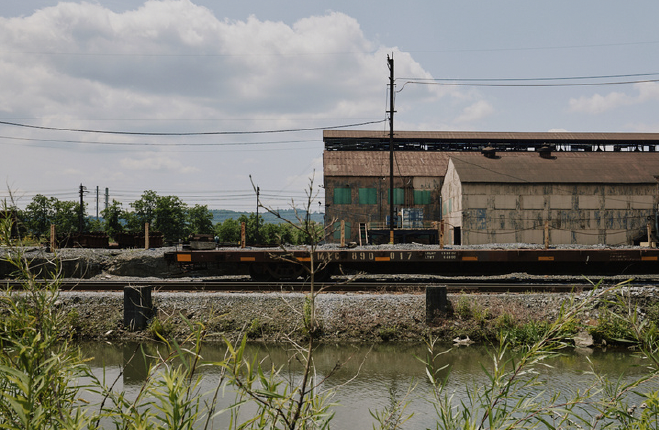
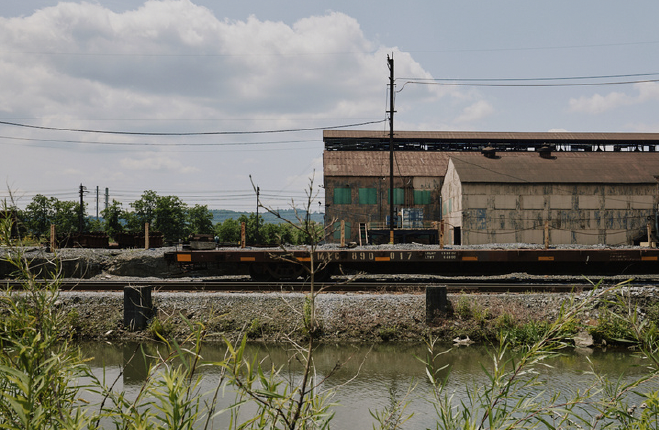
Cleveland-Cliffs/Steelton Plant (formerly Bethlehem Steel) in Steelton, PA (Photo: Rick Snizik)
There’s a lot to be said about the magic that can happen when a group of people pulls together to work towards a common goal. Combining talents, expertise, and collective life experiences to tackle an issue and come up with a solution that reaches far beyond the sum of the original parts.
Such was the case during a recent class collaboration where I and three other MA students formed a small, quickly assembled research group to photograph, write, and produce a presentation based on our shared interest in the effects of humans on climate and the environment. Not a mean feat, either, considering I live in the United States and the other three are located in the UK and Canada, respectively. All in all, it was a very enjoyable experience and got the creative juices flowing in the way that very short deadlines tend to do. To me, at least, it seems we’ve started to take this ability to bring the world together on a single screen for granted, post-pandemic. This level of collaborative ease was very uncommon just a few years ago.
We each investigated specific areas, including the effects of consumerism, palm oil production, air and water pollution, and my area, which was the relationship of excessive atmospheric greenhouse gases to the demonstrable rise in temperature of the earth’s surface (1.1° C since the 1800s!) and the resulting rise in sea levels worldwide.
Doing this exercise really reinforced the idea that working in collaborative authorship with others opens up new avenues of thought and spotlights skills and interests that I wouldn’t have otherwise considered. Working on my own, in a state of semi-isolation as I usually am, has led to my solving problems in rote, repetitive ways and parading new information down the same old neural pathways. Same stuff in, same results out.
A distinction needs to be drawn, though, between collaboration, appropriation, and plagiarism. I’m definitely on board with the idea of collaboration—individuals working together and sharing ideas for a common goal or purpose. It’s a very healthy and beneficial practice when it’s working well.
I’m also okay with appropriating another’s work or output when the creator’s permission is given (assuming you know who they are) to avoid any copyright violations and when proper attributions are given. Is grabbing a street image of someone without their permission an example of bad appropriation? I’m not sure, personally, since I’ve done it, but see Susan Sontag’s opinion on the matter in On Photography for some food for thought.
Outright plagiarism? That’s another story entirely. In my book, it’s simply theft.
Sam Abell, the photographer originally commissioned by Marlboro to shoot its famous cowboy ads, said it best when the artist (provocateur?) Richard Prince began reshooting the ads using Abell’s original images:
“…he must be a cheeky fellow!…It’s obviously plagiarism, and I was taught...the sin of that. It seems to me to be breaking the golden rule, and that’s a higher law than the law of art or commerce. That’s the ultimate law and he has to live with that. What I sense about him is that he can live with that, and that’s a greater achievement than anything – being able to live with breaking the golden rule.”
ABELL, 2008
Concept, Method, & Methodology: Critical Differences
I’ve been thinking recently about how and why photographic works are created.
I’ve been thinking recently about how and why photographic works are created. Not the mechanics of it: compose the scene in the frame, focus, and release the shutter. We all know how that works.
What I’m referring to are the fundamental differences between method, methodology, and concept. I’ve never really understood, or, frankly, even thought about them all that much in my own work until now. If I have, I’ve had them hopelessly confused.
Methods are “processes within various stages of photographic practices, from research and planning, the point of capture, to the choice of output and dissemination.” Essentially, these are the “what” (i.e. what individual things were necessary to complete the project?).
Methodologies are not techniques or specific processes per sé, but are, instead, a system of applying various methods or analyses and discussions that pertain to a certain group of methods. This is the “how”—the overarching “blanket” illustrating how all the pieces came together.
Concept may well be the most misunderstood of the three terms since it’s often used interchangeably and mistakenly with methodology. As stated in the lecture notes, concept is about “describing and defining the rationale, the intention, purpose or even a retrospective analysis” of a methodology.
The concept of a project or body of work is often best expressed in an artist’s statement or statement of intent, a gallery press release, or an essay in a photobook that provides context for a project. However, it’s very important to keep in mind that concepts (note the plurality!) can be many and can develop and change over time as the work progresses.
In fact, (and this is good for me) just beginning a project with nothing more than interest, gut intuition, and the desire to achieve a cohesive project or body of work in the end is often all that’s necessary. No fine-tuned concept is required upfront. Just the desire to follow your interests and experiment with camera in hand and try out as many ideas as possible.
As Victor Burgin said:
“Shoot first and ask questions later.”
(Victor Burgin [1998] in CAMPANY, 2003: 281)
Windows & Mirrors
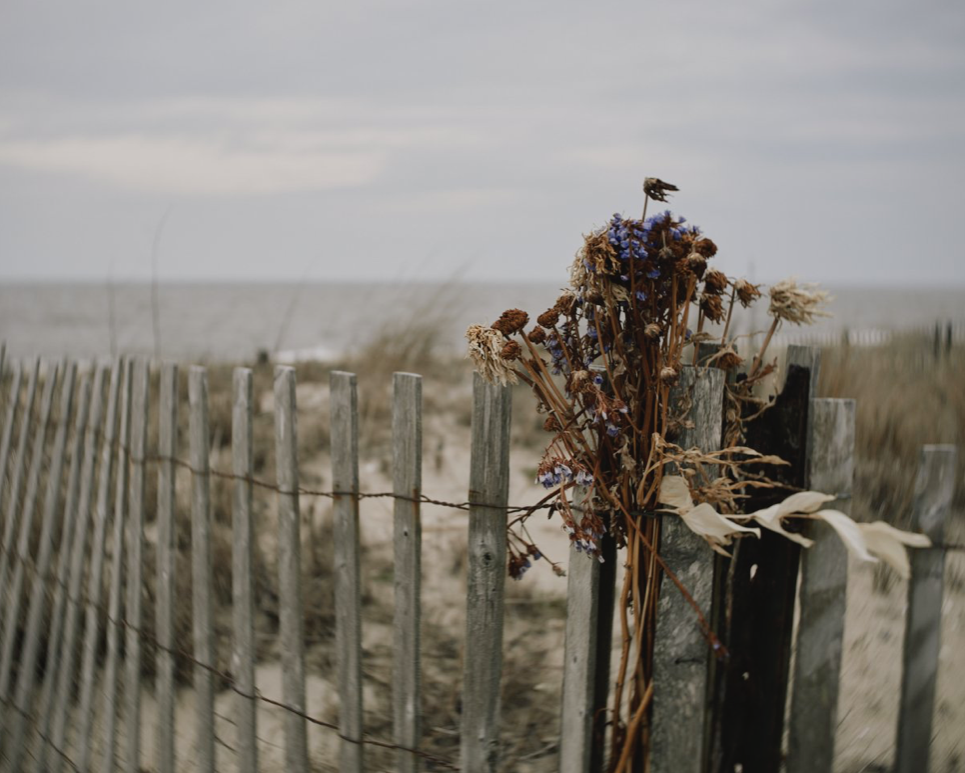
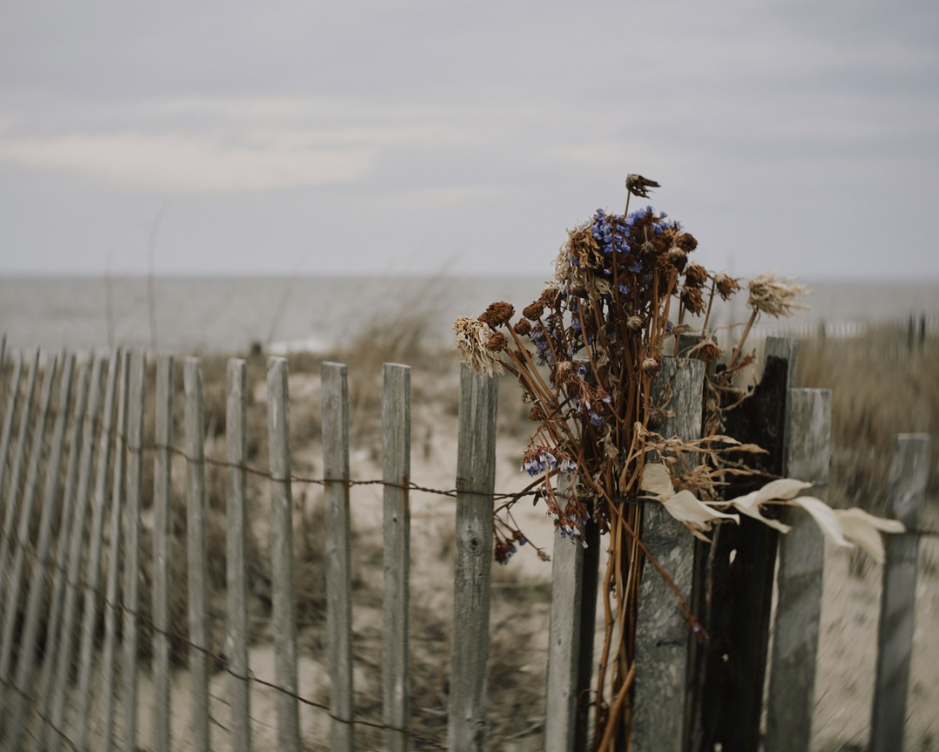
I came across this abandoned floral bouquet stuck into the wire of some dune fencing near Cape May, NJ…
I came across this abandoned bouquet stuck into the wire of a dune fence near Cape May, NJ a few months ago and the symbolism of this bedraggled clump really spoke to me. So many feelings and possible interpretations to unpack here.
Maybe it was meant to show the fragility of love and impermanence of life?
Or, perhaps the opposite? Maybe it's about the ability of love and the human spirit to endure in the face of the harshest conditions.
Maybe a commemorative gesture to remember a drowning victim? Could be, given the roughness of the waters here.
There’s a reason why this token was placed here, but we’ll never know what it is. I love this storytelling aspect of photography. This link between what’s shown in the frame and its connections to the unknowable world that lies just outside it.
Whether I'm shooting something for a commercial purpose or for a personal project, it's always something of which I'm very aware.
As to whether I interpret things more in terms of windows or mirrors, I'd have to say that what I shoot--and the way I frame and compose--is based very much on the way I feel and the way I personally interpret the world. I'm offering a "window" into a subject for others to interpret, but the resulting image is also a snapshot of my own psyche and experiences.