

Climate in Chaos: An Exercise in Collaboration
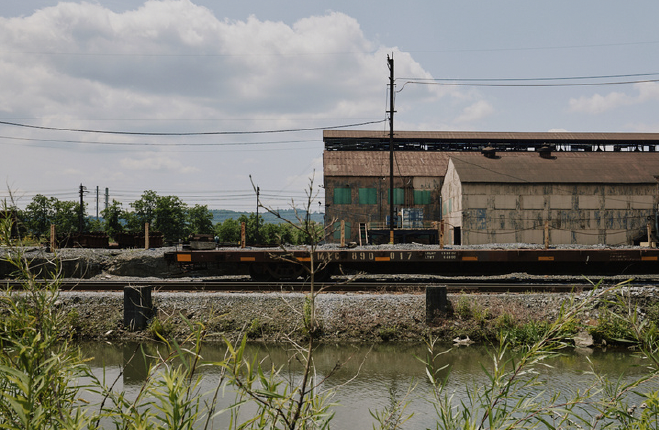
Cleveland-Cliffs/Steelton Plant (formerly Bethlehem Steel) in Steelton, PA (Photo: Rick Snizik)
There’s a lot to be said about the magic that can happen when a group of people pulls together to work towards a common goal. Combining talents, expertise, and collective life experiences to tackle an issue and come up with a solution that reaches far beyond the sum of the original parts.
Such was the case during a recent class collaboration where I and three other MA students formed a small, quickly assembled research group to photograph, write, and produce a presentation based on our shared interest in the effects of humans on climate and the environment. Not a mean feat, either, considering I live in the United States and the other three are located in the UK and Canada, respectively. All in all, it was a very enjoyable experience and got the creative juices flowing in the way that very short deadlines tend to do. To me, at least, it seems we’ve started to take this ability to bring the world together on a single screen for granted, post-pandemic. This level of collaborative ease was very uncommon just a few years ago.
We each investigated specific areas, including the effects of consumerism, palm oil production, air and water pollution, and my area, which was the relationship of excessive atmospheric greenhouse gases to the demonstrable rise in temperature of the earth’s surface (1.1° C since the 1800s!) and the resulting rise in sea levels worldwide.
Doing this exercise really reinforced the idea that working in collaborative authorship with others opens up new avenues of thought and spotlights skills and interests that I wouldn’t have otherwise considered. Working on my own, in a state of semi-isolation as I usually am, has led to my solving problems in rote, repetitive ways and parading new information down the same old neural pathways. Same stuff in, same results out.
A distinction needs to be drawn, though, between collaboration, appropriation, and plagiarism. I’m definitely on board with the idea of collaboration—individuals working together and sharing ideas for a common goal or purpose. It’s a very healthy and beneficial practice when it’s working well.
I’m also okay with appropriating another’s work or output when the creator’s permission is given (assuming you know who they are) to avoid any copyright violations and when proper attributions are given. Is grabbing a street image of someone without their permission an example of bad appropriation? I’m not sure, personally, since I’ve done it, but see Susan Sontag’s opinion on the matter in On Photography for some food for thought.
Outright plagiarism? That’s another story entirely. In my book, it’s simply theft.
Sam Abell, the photographer originally commissioned by Marlboro to shoot its famous cowboy ads, said it best when the artist (provocateur?) Richard Prince began reshooting the ads using Abell’s original images:
“…he must be a cheeky fellow!…It’s obviously plagiarism, and I was taught...the sin of that. It seems to me to be breaking the golden rule, and that’s a higher law than the law of art or commerce. That’s the ultimate law and he has to live with that. What I sense about him is that he can live with that, and that’s a greater achievement than anything – being able to live with breaking the golden rule.”
ABELL, 2008